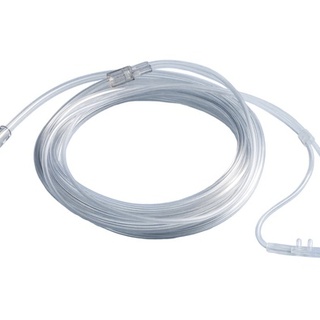
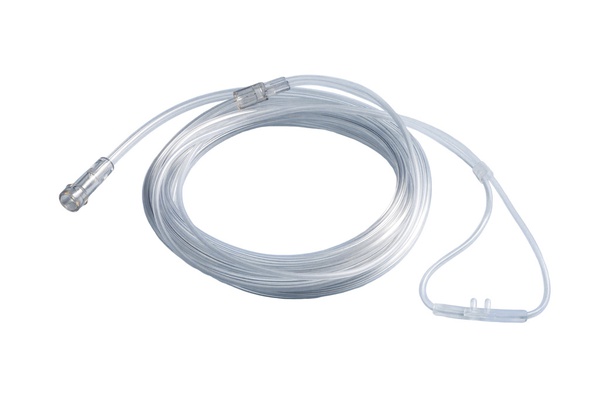
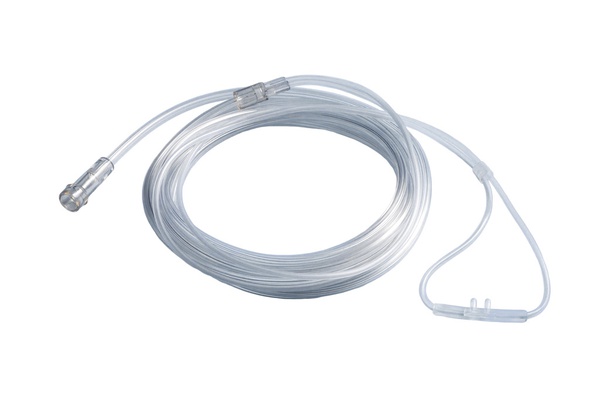
Nasal oxygen cannula Dahlhausen, adults (curved), 50 pcs.
Specifications
Logistics
Product logistics
Box (1 unit)
MiGeL
Chapter:
These products exert their therapeutic effect via the respiratory tract. The products serve the following purposes:
• To support or replace respiratory function in the event of respiratory disorders or respiratory pump failure
• To support or improve coughing function and to help keep the airways clear of secretions (secretion mobilisation)
• Administration of therapeutic aerosols via the respiratory tract; support for powder inhalation
Devices for measuring respiratory function are listed in product group 21: Measuring devices for bodily conditions/functions.
Inhalation and respiratory therapy devices comprise the following product sub-groups:
Inhalation devices
These devices are used to deliver therapeutic aerosols into the airways (inhalation devices). Particle size and mass, measured as MMAD (Mass Median Aerodynamic Diameter, median size of the aerosols in µm), are crucial for the site of deposition (for example, for bronchodilator drugs) when the patient uses the correct inhalation technique. Droplet sizes of 2–5 µm (proportion given as the fine particle fraction in %) are required for deposition in the lung parenchyma, for example, for vasodilator medicines. Devices for metered-dose inhalers and powder inhalers are specific to particular brand-name products and are therefore not listed in the MiGeL but in the Specialities List (SL).
Pre-chambers for metered-dose inhalers
These devices are designed to improve drug deposition when using metered-dose inhalers, particularly in cases of difficulty coordinating the simultaneous inhalation and triggering of the aerosol burst, or where the patient’s willingness to cooperate is limited.
Device repairs under the purchase scheme: reimbursement on a cost basis in cases of careful use where the damage was not self-inflicted, after the warranty has expired and only following prior approval of costs by the health insurer.
Respiratory therapy devices for secretion mobilisation
These devices are designed to facilitate the loosening and removal of mucus from the airways.
Respiratory therapy devices for respiratory muscle training
Respiratory therapy devices for respiratory muscle training promote the mobilisation of secretions and the cough reflex by strengthening the respiratory muscles.
Oxygen therapy
Oxygen therapy is used as short-term therapy (for temporary or end-stage respiratory failure in severe illnesses), as long-term treatment for acute episodes (for cluster headaches) or as long-term oxygen therapy (for chronic lung or respiratory tract diseases).
Long-term oxygen therapy (also known as LTOT):
To achieve the treatment objectives (reduction of pulmonary arterial hypertension, improved life expectancy), oxygen administration is necessary, usually at a low flow rate for at least 16 hours a day.
Indications
Oxygen therapy is administered in accordance with current evidence-based treatment guidelines, even if there is no explicit reference to these in the MiGeL. The basic prerequisite for cost coverage is a diagnosis of cluster headache or a deficiency in oxygen levels (age-adjusted values). Consequently, palliative care patients with dyspnoea but no hypoxaemia should not be treated primarily with oxygen. Opioids are more effective for relieving dyspnoea.
As the complexity of the treatment or the system increases, and for therapies lasting longer than three months, an appropriate indication from a specialist or subspecialist (in exceptional cases in the form of a case assessment based on medical records) is expected. Further prescriptions for long-term, unchanging therapy with simple systems may be issued on a case-by-case basis by GPs. Certain systems require regular specialist assessment.
Choice of system
Depending on the individual situation (indication for oxygen therapy, daily duration of treatment, level of additional oxygen requirement during exertion, living arrangements, changing mobility outside the home), various systems or combinations may be effective, appropriate and cost-effective.
Long-term oxygen therapy using pressurised gas cylinders is obsolete and extremely uneconomical.
Pressurised oxygen cylinders may still be used for short-term therapy, for the long-term treatment of cluster headache attacks, and for the mobile supply of paediatric patients with very low oxygen requirements during long-term oxygen therapy.
Cost approval
To ensure cost-effective treatment, in certain situations (e.g. prior to purchasing expensive systems, before commencing treatment with liquid oxygen, or when combining certain systems), prior special authorisation must be obtained from the insurer, who will take into account the recommendation of the medical examiner.
In the case of liquid oxygen, a cost estimate for the planned supply (oxygen requirement, number and size of tanks, delivery frequency) must already be available prior to the start of treatment in order to obtain the necessary cost approval; this is required to compare the cost-effectiveness and suitability of the supply with other systems.
Similarly, such a cost estimate must be available for the purchase of oxygen concentrators, setting out the specific and expected replacement intervals for the molecular sieve and, where applicable, batteries – including their prices – for the selected model.
Portable systems
Long-term oxygen therapy using a portable system requires a prior, correct assessment and a regularly updated medical indication from specialist doctors, and necessitates specific instruction from specialist support staff.
Mobility whilst travelling and outside the home refers to situations that regularly arise in the course of the insured person’s normal daily life, where they are beyond the reach of a stationary oxygen source and therefore require off-grid systems. Thus, the use of an oxygen concentrator at second homes with an existing mains supply does not constitute portable use, as stationary oxygen concentrators are suitable for carrying in a car. The medical indication for portable systems is determined in accordance with current treatment guidelines. In the case of reimbursement for portable systems intended for use whilst travelling and outside the home (portable oxygen concentrators, liquid oxygen), a special annual authorisation from the insurer is sometimes required in order to accommodate any changes in the insured person’s mobility outside the home. For people who no longer leave their home, more suitable and cost-effective systems may be available. Even without the need for special authorisation, the insurer may require evidence that, in the individual case, no other system is appropriate and that the system remains cost-effective in comparison.
When renting a portable oxygen concentrator, authorisation for costs must be obtained from the insurer before continuing treatment after 3 months. During this period, the treatment – including any trigger function – should have been sufficiently tested, and the therapeutic benefits achieved and expected must be demonstrated. With regard to the cost-effectiveness of the planned treatment, this must now be weighed up against the purchase of the device.
Spare parts for oxygen concentrators following purchase
The service life of molecular sieves varies depending on the device model. Batteries for portable oxygen concentrators must be replaced at varying intervals, depending on usage and the device model. The market prices of both spare parts vary considerably and, over several years of use, influence the cost-effectiveness of the chosen treatment. For this reason, the application for prior authorisation of costs must be accompanied by the relevant device-specific details for the intended supply before the device is purchased. The actual reimbursement will be based on this estimate, but will not exceed the maximum reimbursement amount.
Consumables
Only one of the consumables items per insured person is reimbursed per year, regardless of the number of oxygen systems used. A change to the flat-rate allowance during the course of the year is possible, e.g. in the event of a corresponding adjustment to the treatment. Persons who utilise the consumables item for oxygen requirements under physical exertion of 6 l/min or higher must also use a correspondingly high-capacity oxygen source or system (liquefied gas, stationary concentrator with high oxygen flow, or compressed gas in the case of cluster headaches).
Technical notes
Medical oxygen is a medicinal product whose reimbursement is, exceptionally and on a temporary basis, still regulated under the MiGeL until it is listed in the Specialities List. Pressurised gas cylinders:
They are filled to 200 bar (MPa). One litre of pressurised gas yields 200 litres of gaseous oxygen.
Liquid oxygen:
It is stored in a thermally insulated container. Boiling point of O₂ = –183 °C. 1 litre of liquid oxygen yields 860 litres of gaseous oxygen.
Devices for the treatment of sleep-related breathing disorders
Devices for the ventilatory treatment of sleep-related breathing disorders (CPAP [Continuous Positive Airway Pressure] devices, servo-ventilation devices, bi-level PAP devices) generate a constant positive pressure in the airways, which ‘keeps them open’. Devices for non-ventilatory respiratory support (mandibular advancement splints) prevent obstruction of the pharynx by mechanically advancing the lower jaw.
In accordance with Article 17(f) of the Health Insurance Cost Reimbursement Ordinance (KLV) and Article 19(e) of the KLV, the insurer covers the costs of dental treatment.
Devices for mechanical home ventilation
Ventilators which, in the event of ventilatory insufficiency, temporarily support (respiratory support devices) or replace (devices for people who are permanently dependent on the device) respiratory function.
Repairs to medical devices under the purchase scheme: Reimbursement based on actual costs in the event of careful use and where the damage is not the patient’s fault, after the warranty has expired and only subject to prior approval of costs by the health insurer.
Various systems are available for oxygen therapy, all of which offer equivalent therapeutic benefits. Depending on consumption, the duration of use and mobility requirements, the most cost-effective system should be selected in each case (further information on this can be found in Chapter 5 of the Preliminary Remarks).
Consumables are reimbursed on a per-patient, per-year basis, regardless of the number of systems or devices used for oxygen therapy. Only one flat-rate payment is made per patient (subject to change in the event of adjustments to the therapy during the course of the year).
What is the HVB?
The maximum reimbursement amount (HVB) is the most the compulsory health insurance (OKP) reimburses, including VAT. If the insured person uses the product themselves or with help from relatives, the HVB self-application applies. If nursing professionals apply it, in an institution, with home care or self-employed, the reduced HVB care applies. Any amount above the HVB, the deductible and the co-payment are borne by the insured person.
Full text in the explanations below-
14.10.60.00.1Consumables for oxygen therapy where oxygen requirements during exertion are ≤ 6 litres of O₂ per minute
Purchase
The last digit of the item number indicates what the item is for: 1 = purchase, 2 = hire, 3 = purchase and hire. Accessories ending in 1 are only reimbursed for purchased equipment; those ending in 2 are only reimbursed for hired equipment.
Full text in the explanations below- Care
- 167.12
- Self-application
- 185.69
Per year (pro rata)
‘per year (pro rata)’: reimbursement is based on the proportion of the calendar year during which the treatment is ongoing (starting on 1 October: one quarter). ‘per year’: no more than once every 365 days from the date of the first claim. ‘Per calendar year’: the full amount for the current calendar year, regardless of when it begins.
Full text in the explanations belowShow more details Hide more details
(includes oxygen goggles and masks, oxygen tubing, tubing connectors, Firesafe, non-return valves, pressure ulcer protection and water traps)
Show limitation Hide limitation applies to 14.10.60.00.1 (chapter 14.10)
The following criteria apply to oxygen therapy: • Oxygen deficiency confirmed using appropriate methods (e.g. oxygen saturation, blood gas analysis) or • A diagnosis of cluster headache To continue treatment after 3 months, an indication for oxygen therapy and its modality must also be provided • by specialists in the following fields: paediatrics and adolescent medicine with a specialisation in paediatric pulmonology (Specialist training programme dated 1 July 2004, revised on 16 June 2016. The document is available at: www.bag.admin.ch/ref) or respiratory medicine • or, in the case of patients in palliative care at the end of life, by specialists in the following disciplines: paediatrics and adolescent medicine, or respiratory medicine, or general internal medicine • in the case of a diagnosis of cluster headache, by specialists in neurology
Show limitation Hide limitation applies to 14.10.60.00.1
Not applicable to items 14.10.61.00.1 and 14.10.62.00.1
Show explanations Hide explanations
2.2 MiGeL Remuneration Scheme (Art. 20 et seq. KLV)
Where used directly by insured persons, or where necessary with the assistance of persons not professionally involved in the examination or treatment, or where used in the context of the provision of care services by self-employed nursing professionals or organisations providing nursing and home help, the OKP will reimburse the medical devices and items listed in the MiGeL up to the maximum reimbursement amount for self-administration specified in the MiGeL (HVB self-application; Art. 24(1) KLV), provided that these:
- correspond to the product description of a MiGeL item
- have been placed on the market in accordance with federal or cantonal legislation
- fulfil the required therapeutic purpose or the purpose of monitoring the treatment of a disease and its consequences
- are prescribed by a doctor
- are dispensed by a dispensing outlet authorised in accordance with Article 55 of the KVV.
Medicines and medical devices used by insured persons directly or, where applicable, with the assistance of persons not professionally involved in the examination or treatment may also be prescribed by a chiropractor under Article 4(c) of the Health Insurance Ordinance (KLV).
Where the remedies and items are used whilst the insured person is staying in a care home, or where invoices are issued by nursing staff or by organisations providing nursing care and home help, the OKP will reimburse the remedies and items listed in the MiGeL up to the reduced HVB rate specified in the MiGeL (= HVB care; Art. 24(2) KLV), provided that the conditions set out above under points (a) to (d) are met.
Medical devices and supplies that do not correspond to the product description of a MiGeL item must not be billed to the OKP. Billing under a similar item number is not permitted.
If the medical devices and supplies are products falling within the scope of the Medical Devices Ordinance (MepV; SR 812.213), they must comply with the requirements of the MepV regarding their placing on the Swiss market (Art. 23 KLV). Supervision and enforcement of the MepV are the responsibility of Swissmedic, the Swiss Agency for Therapeutic Products, Medical Devices Division, Hallerstrasse 7, P.O. Box, CH-3012 Bern.
Where the products and articles are foodstuffs as defined in Article 2(d) of the EDI Ordinance on Foodstuffs for Persons with Special Nutritional Needs (VLBE; SR 817.022.104) (foodstuffs for special medical purposes; see also Chapter 3 of the VLBE), they must comply with the requirements of the VLBE when placed on the Swiss market (Art. 23 KLV). Supervision and enforcement of the VLBE are the responsibility of the cantons.
The HVB is specified for each product type of products and devices. For products and devices which are used by the insured person themselves or with the assistance of a person not professionally involved in the examination or treatment, the HVB self-application applies. For medicinal products and medical devices which can be used both by the insured person themselves (or with the assistance of a person not professionally involved in the examination or treatment) and as part of a care service under Article 25a of the KVG, the reduced HVB care applies if the product is used during the insured person’s stay in a care home or is invoiced by nursing staff or by organisations providing nursing care and home help. The HVB rates listed in the MiGeL represent the maximum amount that can be reimbursed by insurers under the OKP (Art. 24(3) KLV). The insured person is free to choose a specific suitable product within the scope of this HVB, in which case any additional cost (Art. 24(3) KLV) shall be borne by the insured person. When dispensing medical supplies and equipment during the insured person’s stay in a care home, whether by nursing staff or by organisations providing nursing care and home help, cost-effective products should be chosen wherever possible so that the maximum reimbursement limit can be adhered to. It is the duty of service providers to inform the insured person of any costs not covered by the OKP. Medical aids and equipment are not included in tariff cover (Art. 44(1) KVG). Insurers may agree tariffs with care homes, home nursing and care organisations or nursing staff, in accordance with Article 46 of the KVG, for the reimbursement of medical devices and supplies listed in the MiGeL (Art. 24(6) KLV).
Value added tax (VAT) is included in these amounts. The actual price including VAT (currently 8.1% for products falling within the scope of the Medical Devices Ordinance and 2.6% for products falling within the scope of the FDHA Ordinance on Foodstuffs for Persons with Special Nutritional Needs) is decisive for billing purposes.
The MiGeL reference prices generally correspond to the average price of suitable products available on the market. Prices abroad are taken into account in the cost-effectiveness assessment.
Furthermore, for medicinal products and medical devices, the insured person’s contribution to costs in the form of an excess and a deductible (see Art. 64 KVG, Art. 103 KVV) also applies to the maximum reimbursable amount.
4.1 Product groups
The list is divided into product groups according to the function of the products. A distinctive feature of the MiGeL, compared with other lists under compulsory health insurance, is that it only lists general product descriptions and does not include individual brand names.
Provisions listed under the heading of a product group or sub-group apply to all items within that group (e.g. different formats for dressing materials).
The existing product groups list products which may be used either by the insured person themselves or with the assistance of a person not professionally involved in the examination or treatment, as well as within the framework of a care service under Article 25a of the Health Insurance Act (KVG) (corresponding to Category B). Where the product is used by the insured person themselves (or with the assistance of a person not professionally involved in the examination or treatment), the HVB applies (= HVB self-application; Art. 24(1) KLV). Where the product is used whilst the insured person is staying in a care home, or where it is invoiced by nursing staff or by organisations providing nursing care and home help, a reduced HVB care applies (= HVB care; Art. 24(2) KLV).
Medicines and medical devices which can only be administered or applied by nursing staff, and not by the insured person themselves or by a person not involved in a professional capacity, are classified in Category C of the MiGeL. As these products can only be administered or applied by nursing staff, there is only one HVB care co-payment.
Simple consumables directly related to nursing care (e.g. gloves, gauze, disinfectants, masks and protective clothing), as well as materials and items for multiple use across different patients (e.g. blood pressure monitors, stethoscopes, clinical thermometers, special ergonomic pillows, reusable instruments such as scissors and tweezers) are classified in category A. Category A products are not included in the MiGeL and are reimbursed in accordance with the rules on nursing care funding set out in Articles 25 and 25a of the Health Insurance Act (KVG) and Articles 7 et seq. of the Health Insurance Ordinance (KLV).
4.2 Item numbers
The first two digits of the item number indicate the product group. The following pairs of digits, separated by a full stop, indicate, in turn, the category and sub-categories, the specific product and the accessories / consumables. The final single digit indicates whether the item is applicable under the hire and/or purchase scheme. Digit 1 = purchase, 2 = hire, 3 = purchase and hire. An item number for the purchase of a device ends with the digit 1, and an item number for the hire of a device ends with the digit 2. For items relating to accessories, consumables and other charges (e.g. delivery) associated with a device, items ending in 1 may only be charged additionally when the corresponding device is purchased, and items ending in 2 may only be charged additionally when the device is hired. Items ending in 3 may be charged additionally in relation to a purchased or rented item of equipment.
4.3 Allocation: Rent / Purchase, Aggregation of Items
Separate items are listed for hire and purchase (Art. 24(4) KLV). The unit of the amount listed (e.g. unit price, daily hire charge, etc.) is specified for each item. Insurers shall cover the costs, within the limits of the applicable HVB, only for aids and appliances that are in a ready-to-use condition. In the case of aids and appliances acquired by purchase, the insurer shall cover the costs of any necessary adaptation and maintenance, provided this is specified in the list. In the case of hire, maintenance and adaptation costs are included in the hire price (Art. 24(5) KLV).
Items with different therapeutic or diagnostic functions may generally be combined. Accessories and consumables may only be combined with the corresponding product. Any exceptions or notes are listed in each case.
4.4 Limitations
Products may generally be subject to restrictions regarding their medical indication, quantity and duration of use. A product subject to a restriction is marked with an ‘L’ after the item number. Restrictions may apply to individual products, product sub-groups or entire product groups. Relevant information is provided for each item.
4.6 ‘per year’, ‘pro rata’ and ‘per calendar year’
Treatment, or the purchase of relevant products, often does not begin on 1 January of a given year. Reimbursement under an HVB ‘per year (pro rata)’ always relates to the portion of the calendar year during which the treatment was actually used.
For example: A first-time purchase of consumables for regular use is made with an HVB of CHF 400 per year, pro rata from 1 October. In the year of the first purchase, the corresponding proportion of the annual reimbursement limit remaining for that calendar year (3 months) is to be reimbursed, i.e. CHF 100 (pro rata). In the following year, the treatment continues on a permanent basis and a maximum of CHF 400 may be reimbursed for the entire calendar year. If supplies amounting to CHF 100 are purchased as early as October, this falls within the annual reimbursement limit ‘per year (pro rata)’, even if the monthly cost works out at CHF 33.33. The annual (pro rata) reimbursement limit allows for fluctuations in requirements during the course of treatment. The rounding rule is that reimbursement is usually rounded up to whole units, e.g. if a product needs to be replaced every two weeks.
HVB ‘per year’ is mostly used for devices or medical aids that are not purchased several times a year, or that are used irregularly. It is understood to be the maximum possible reimbursement over the 365 days from the first date of purchase. This does not mean per calendar year, but per year of ongoing treatment.
For example: spectacle lenses and contact lenses are reimbursed under an HVB a maximum of once a year until the age of 18. If the first purchase is made on 31 October 2015, reimbursement can be claimed again at the earliest for a purchase in November 2016.
As an exception, items that are purchased several times a year but used irregularly may also be eligible for one HVB per year. One example is blood glucose test strips for people with diabetes who do not require insulin. In this case, once-daily use (corresponding to a pro rata reimbursement) is medically justified only in a few exceptional cases. However, short periods of more frequent testing, e.g. for changes in treatment, should be permitted. At the same time, this takes into account that even if blood glucose monitoring begins towards the end of the year, a small pack of test strips can still be reimbursed initially.
HVB ‘per calendar year’ can be reimbursed up to a maximum in the relevant calendar year, regardless of when the first prescription was issued. It is used when, in the case of long-term treatment, the initial costs for supplies are high and may therefore no longer be covered by a ‘pro rata’ arrangement if treatment only begins towards the end of the year.
An example: A person is discharged from hospital on 1 October with a newly performed tracheostomy. For the remaining 3 months of the year, the full HVB is available ‘per calendar year’ for consumables. This contrasts with the HVB ‘per year (pro rata)’, under which only a quarter of the HVB would be reimbursed for a period of 3 months.
4.7 Descriptions in the ‘HVB care’ column
As a general rule, the HVB column contains the maximum reimbursement amount. In exceptional cases, a MiGeL item may not contain an HVB care or a note:
- The following items do not contain an HVB specification:
- Remuneration in accordance with items in the SVOT tariff
- Remuneration in accordance with items in the OSM tariff
- Remuneration in accordance with the UV / MV / IV commercial goods tariff
- Remuneration in accordance with the provisions of the AHV / IV
- Dressing aids: reimbursement only for self-administration
- Reimbursement in accordance with the rules on nursing care funding under Articles 25 and 25a of the Health Insurance Act (KVG) and Articles 7 et seq. of the Health Insurance Ordinance (KLV)
- ‘Category A’ comprises items that are reimbursed in the context of self-application in accordance with the HVB self-application guidelines. Where administered by nursing staff, reimbursement is made in accordance with the rules on care funding under Articles 25 and 25a of the KVG and Articles 7 et seq. of the KLV
4.8 Non-standard formats / volumes / weight specifications
For formats, volumes or weights not listed here or which differ from those listed, the maximum reimbursement amount for the format, volume or weight closest in size shall apply. Areas falling midway between two sizes are allocated to the smaller size, whilst volumes or weights falling midway are allocated to the smaller entry.
6 Abbreviations
- Abs.
- Paragraph
- AHV
- Old-Age and Survivors’ Insurance
- Art.
- Article
- BAG
- Federal Office of Public Health
- Bst.
- Sub-paragraph
- BBL
- Federal Office for Buildings and Logistics
- BSV
- Federal Office for Social Insurance
- EDI
- Federal Department of Home Affairs
- HVB
- maximum reimbursement amount
- IV
- Disability insurance
- KLV
- Ordinance of the Federal Department of Home Affairs (EDI) of 29 September 1995 on Benefits under Compulsory Health Insurance (Health Insurance Benefits Ordinance)
- KVG
- Federal Act of 18 March 1994 on Health Insurance
- KVV
- Ordinance of 27 June 1995 on Health Insurance
- L
- Limit
- MepV
- Medical Devices Ordinance (SR 812.213)
- MiGeL
- List of Medicines and Medical Devices
- MV
- Military Insurance
- MWST
- Value Added Tax
- OSM-Tarif
- Tariff for orthopaedic and footwear-related work of the Swiss Association of Master Shoemakers and Orthopaedic Shoemakers (SSOMV)
- Rev.
- Revision: Type of revision for an item in the current MiGeL:
- B
- Change to the maximum reimbursement amount for self-administration
- C
- textual modification
- N
- New item
- P
- Change to the maximum reimbursement amount for care
- S
- Deletion
- V
- Extension of the obligation to provide benefits
- SL
- List of specialities
- SVOT
- Swiss Association of Orthopaedic Technicians
- TP-Wert
- Tax point value
- UV
- Accident insurance
- UVG
- Federal Act of 20 March 1981 on Accident Insurance
- WHO
- World Health Organisation
- Ziff.
- Item
Translation by Sana Swiss. The German text is authoritative.
Only logged-in customers who have bought this product can review it. Log in · Learn more