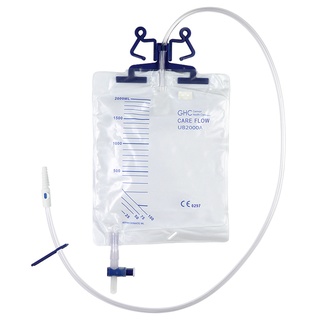
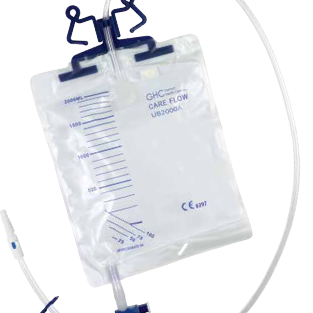
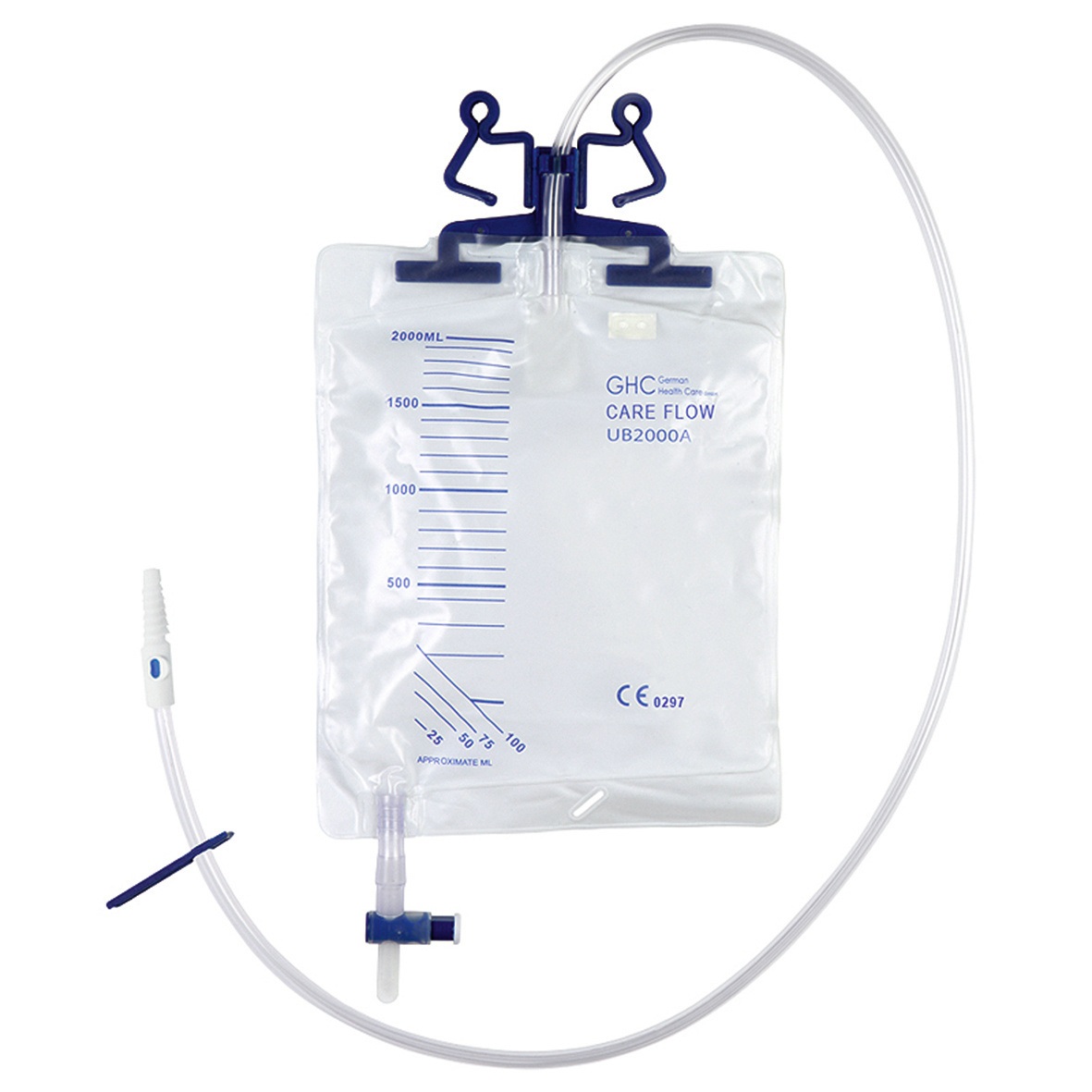
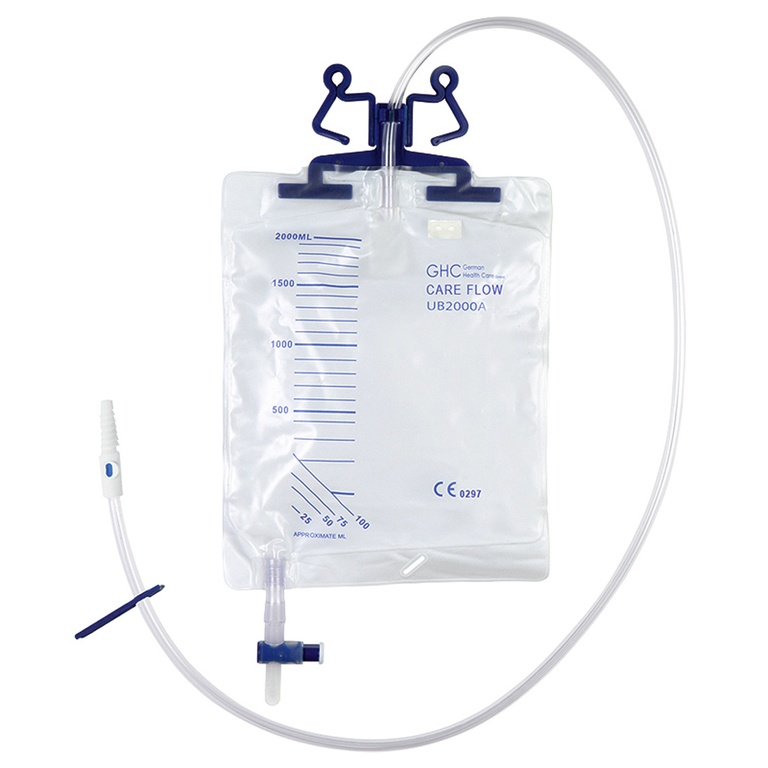
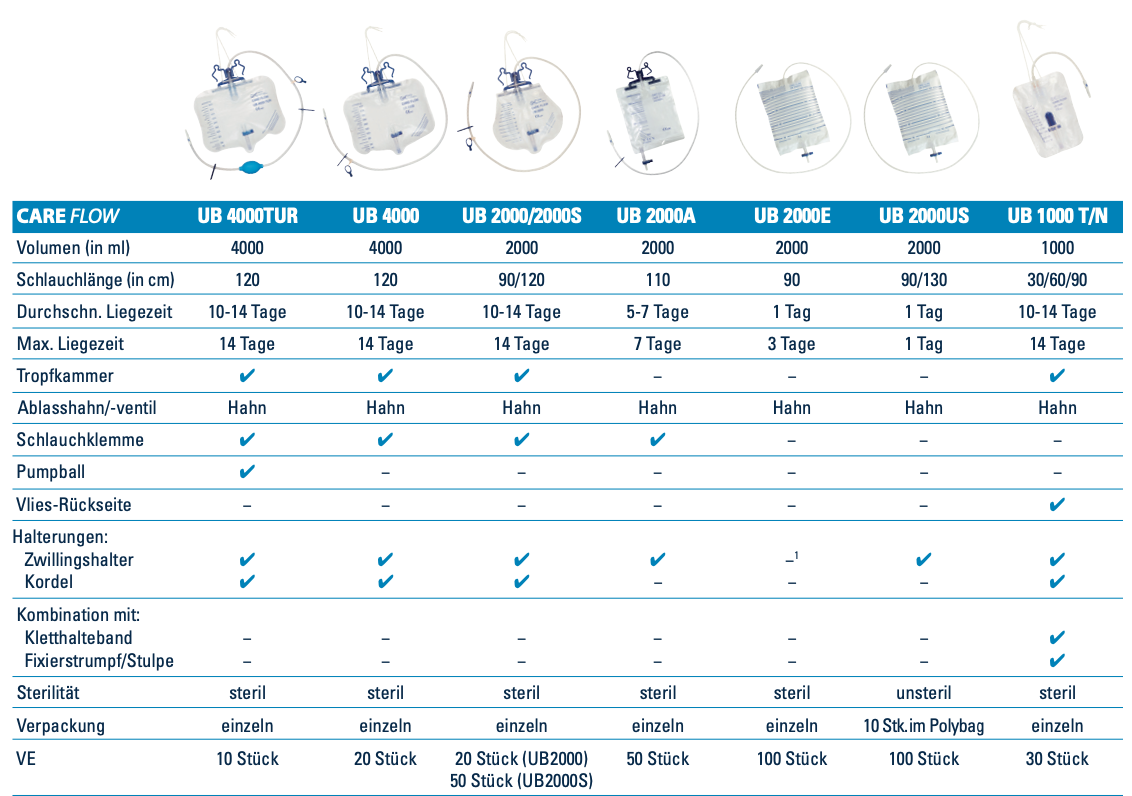
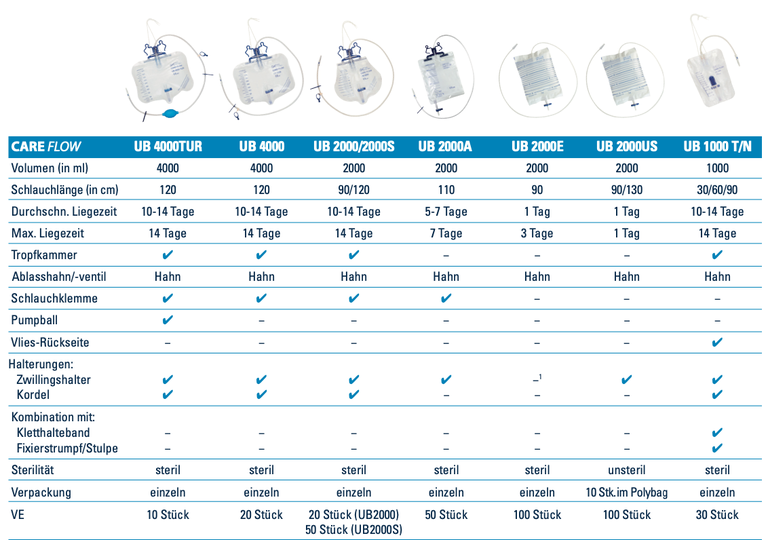
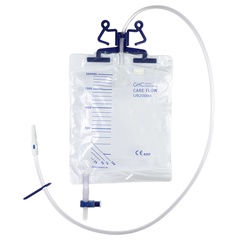
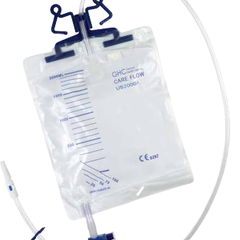
GHC bed bag CAREFLOW UB 2000A, 2000ml, 110cm, sterile
Sterile bed bag with an integrated twin holder.
Specifications
Description
Product specifications:
- Twin holder with an additional fastening cord allows for secure attachment to various bed rails.
- A reflux valve reliably prevents urine from flowing back out of the system. This effectively prevents the risk of ascending infections.
- Clear graduation scale
- A tuck-back slot ensures the secure and hygienic positioning of the drain valve
- T-drain valve
- Kink-resistant tubing
- Step connector: The special alignment of the connector steps ensures a reliable connection with the ring reinforcement in the catheter funnel. Needle-free urine sampling prevents needle-stick injuries.
- Ventilation filter: A bacteria- and liquid-tight ventilation filter ensures constant pressure equalization. This achieves optimal drainage within the system.
- Profiled tube: The octagonal inner profile of the supply tube ensures excellent stability. The large-bore, flexible tube thus guarantees safe urine drainage to the drip chamber in every situation.
- Drain valve: A special raised ridge on the drain valve's plunger ensures easy and safe handling. This prevents leaks caused by pushing the plunger too far forward.
Logistics
Product logistics
Piece (1 unit)
Box (50 units)
MiGeL
Chapter:
This product group includes absorbent and drainage incontinence aids, as well as accessories and therapeutic devices. Incontinence is the inability to voluntarily control the passage of urine and/or faeces, resulting in the involuntary loss of urine and/or faeces.
Degrees of incontinence in adults:
Mild incontinence does not qualify for reimbursement of absorbent incontinence products by the OKP. This includes stress incontinence, characterised by the loss of small amounts of urine during certain physical activities such as sneezing, coughing, laughing or exercise. In such cases, incontinence products are the patient’s own responsibility until other, long-term forms of treatment prove effective.
Moderate incontinence: Unintentional leakage of urine (part of the bladder’s contents) at irregular intervals, up to several times a day.
Severe incontinence: Involuntary, sudden and complete emptying of the bladder, up to several times a day.
Total incontinence: Frequent and constant involuntary leakage of urine and/or faeces.
During normal childhood development, bowel and bladder control are acquired gradually. A distinction must be made between daytime bowel and bladder control – which develop largely at the same time – and night-time bladder control, which usually does not develop until later.
Entitlement to reimbursement for products used to treat medical conditions under item 15.01 (absorbent incontinence products) therefore arises at the earliest from the age of 42 months. By this age, the majority of children have acquired daytime bowel and bladder control. Due to medical conditions, it may be that this function is only acquired at a later stage.
Incontinence pads
Technical specifications:
Absorbent, liquid-retaining material as an absorbent pad. Back-wetness protection / non-woven layer on the inside. Liquid-impermeable outer layer. Leak protection around all edges. All-round edge-to-edge bonding of the inner and outer layers. Skin-friendly materials.
Vaginal pessaries
Vaginal pessaries correct the position of the pelvic organs, thereby improving continence function.
Vaginal pessaries can be cleaned with warm water and reinserted repeatedly over a period of months or even years. Depending on the situation and requirements, various shapes are used, such as ring pessaries, cup/sieve-cup pessaries, cube pessaries, urethral pessaries, etc.
Disposable and short-term pessaries made from special foams, vinyl and/or cellulose can, depending on the material, be used once or reinserted repeatedly for a few days to a few weeks after cleaning with warm water. They are usually sold in multipacks.
Contraceptive pessaries, such as intrauterine devices or diaphragms, are excluded from reimbursement.
Urine/secretion bed pouches are also used as secretion pouches in Chapter 03.01, ‘Application aids for artificial feeding’.
What is the HVB?
The maximum reimbursement amount (HVB) is the most the compulsory health insurance (OKP) reimburses, including VAT. If the insured person uses the product themselves or with help from relatives, the HVB self-application applies. If nursing professionals apply it, in an institution, with home care or self-employed, the reduced HVB care applies. Any amount above the HVB, the deductible and the co-payment are borne by the insured person.
Full text in the explanations below-
15.15.04.00.1Urine/secretion bed bag, with drain, sterile
Purchase
The last digit of the item number indicates what the item is for: 1 = purchase, 2 = hire, 3 = purchase and hire. Accessories ending in 1 are only reimbursed for purchased equipment; those ending in 2 are only reimbursed for hired equipment.
Full text in the explanations below- Care
- 3.30
- Self-application
- 3.66
1 item
Show explanations Hide explanations
2.2 MiGeL Remuneration Scheme (Art. 20 et seq. KLV)
Where used directly by insured persons, or where necessary with the assistance of persons not professionally involved in the examination or treatment, or where used in the context of the provision of care services by self-employed nursing professionals or organisations providing nursing and home help, the OKP will reimburse the medical devices and items listed in the MiGeL up to the maximum reimbursement amount for self-administration specified in the MiGeL (HVB self-application; Art. 24(1) KLV), provided that these:
- correspond to the product description of a MiGeL item
- have been placed on the market in accordance with federal or cantonal legislation
- fulfil the required therapeutic purpose or the purpose of monitoring the treatment of a disease and its consequences
- are prescribed by a doctor
- are dispensed by a dispensing outlet authorised in accordance with Article 55 of the KVV.
Medicines and medical devices used by insured persons directly or, where applicable, with the assistance of persons not professionally involved in the examination or treatment may also be prescribed by a chiropractor under Article 4(c) of the Health Insurance Ordinance (KLV).
Where the remedies and items are used whilst the insured person is staying in a care home, or where invoices are issued by nursing staff or by organisations providing nursing care and home help, the OKP will reimburse the remedies and items listed in the MiGeL up to the reduced HVB rate specified in the MiGeL (= HVB care; Art. 24(2) KLV), provided that the conditions set out above under points (a) to (d) are met.
Medical devices and supplies that do not correspond to the product description of a MiGeL item must not be billed to the OKP. Billing under a similar item number is not permitted.
If the medical devices and supplies are products falling within the scope of the Medical Devices Ordinance (MepV; SR 812.213), they must comply with the requirements of the MepV regarding their placing on the Swiss market (Art. 23 KLV). Supervision and enforcement of the MepV are the responsibility of Swissmedic, the Swiss Agency for Therapeutic Products, Medical Devices Division, Hallerstrasse 7, P.O. Box, CH-3012 Bern.
Where the products and articles are foodstuffs as defined in Article 2(d) of the EDI Ordinance on Foodstuffs for Persons with Special Nutritional Needs (VLBE; SR 817.022.104) (foodstuffs for special medical purposes; see also Chapter 3 of the VLBE), they must comply with the requirements of the VLBE when placed on the Swiss market (Art. 23 KLV). Supervision and enforcement of the VLBE are the responsibility of the cantons.
The HVB is specified for each product type of products and devices. For products and devices which are used by the insured person themselves or with the assistance of a person not professionally involved in the examination or treatment, the HVB self-application applies. For medicinal products and medical devices which can be used both by the insured person themselves (or with the assistance of a person not professionally involved in the examination or treatment) and as part of a care service under Article 25a of the KVG, the reduced HVB care applies if the product is used during the insured person’s stay in a care home or is invoiced by nursing staff or by organisations providing nursing care and home help. The HVB rates listed in the MiGeL represent the maximum amount that can be reimbursed by insurers under the OKP (Art. 24(3) KLV). The insured person is free to choose a specific suitable product within the scope of this HVB, in which case any additional cost (Art. 24(3) KLV) shall be borne by the insured person. When dispensing medical supplies and equipment during the insured person’s stay in a care home, whether by nursing staff or by organisations providing nursing care and home help, cost-effective products should be chosen wherever possible so that the maximum reimbursement limit can be adhered to. It is the duty of service providers to inform the insured person of any costs not covered by the OKP. Medical aids and equipment are not included in tariff cover (Art. 44(1) KVG). Insurers may agree tariffs with care homes, home nursing and care organisations or nursing staff, in accordance with Article 46 of the KVG, for the reimbursement of medical devices and supplies listed in the MiGeL (Art. 24(6) KLV).
Value added tax (VAT) is included in these amounts. The actual price including VAT (currently 8.1% for products falling within the scope of the Medical Devices Ordinance and 2.6% for products falling within the scope of the FDHA Ordinance on Foodstuffs for Persons with Special Nutritional Needs) is decisive for billing purposes.
The MiGeL reference prices generally correspond to the average price of suitable products available on the market. Prices abroad are taken into account in the cost-effectiveness assessment.
Furthermore, for medicinal products and medical devices, the insured person’s contribution to costs in the form of an excess and a deductible (see Art. 64 KVG, Art. 103 KVV) also applies to the maximum reimbursable amount.
4.1 Product groups
The list is divided into product groups according to the function of the products. A distinctive feature of the MiGeL, compared with other lists under compulsory health insurance, is that it only lists general product descriptions and does not include individual brand names.
Provisions listed under the heading of a product group or sub-group apply to all items within that group (e.g. different formats for dressing materials).
The existing product groups list products which may be used either by the insured person themselves or with the assistance of a person not professionally involved in the examination or treatment, as well as within the framework of a care service under Article 25a of the Health Insurance Act (KVG) (corresponding to Category B). Where the product is used by the insured person themselves (or with the assistance of a person not professionally involved in the examination or treatment), the HVB applies (= HVB self-application; Art. 24(1) KLV). Where the product is used whilst the insured person is staying in a care home, or where it is invoiced by nursing staff or by organisations providing nursing care and home help, a reduced HVB care applies (= HVB care; Art. 24(2) KLV).
Medicines and medical devices which can only be administered or applied by nursing staff, and not by the insured person themselves or by a person not involved in a professional capacity, are classified in Category C of the MiGeL. As these products can only be administered or applied by nursing staff, there is only one HVB care co-payment.
Simple consumables directly related to nursing care (e.g. gloves, gauze, disinfectants, masks and protective clothing), as well as materials and items for multiple use across different patients (e.g. blood pressure monitors, stethoscopes, clinical thermometers, special ergonomic pillows, reusable instruments such as scissors and tweezers) are classified in category A. Category A products are not included in the MiGeL and are reimbursed in accordance with the rules on nursing care funding set out in Articles 25 and 25a of the Health Insurance Act (KVG) and Articles 7 et seq. of the Health Insurance Ordinance (KLV).
4.2 Item numbers
The first two digits of the item number indicate the product group. The following pairs of digits, separated by a full stop, indicate, in turn, the category and sub-categories, the specific product and the accessories / consumables. The final single digit indicates whether the item is applicable under the hire and/or purchase scheme. Digit 1 = purchase, 2 = hire, 3 = purchase and hire. An item number for the purchase of a device ends with the digit 1, and an item number for the hire of a device ends with the digit 2. For items relating to accessories, consumables and other charges (e.g. delivery) associated with a device, items ending in 1 may only be charged additionally when the corresponding device is purchased, and items ending in 2 may only be charged additionally when the device is hired. Items ending in 3 may be charged additionally in relation to a purchased or rented item of equipment.
4.3 Allocation: Rent / Purchase, Aggregation of Items
Separate items are listed for hire and purchase (Art. 24(4) KLV). The unit of the amount listed (e.g. unit price, daily hire charge, etc.) is specified for each item. Insurers shall cover the costs, within the limits of the applicable HVB, only for aids and appliances that are in a ready-to-use condition. In the case of aids and appliances acquired by purchase, the insurer shall cover the costs of any necessary adaptation and maintenance, provided this is specified in the list. In the case of hire, maintenance and adaptation costs are included in the hire price (Art. 24(5) KLV).
Items with different therapeutic or diagnostic functions may generally be combined. Accessories and consumables may only be combined with the corresponding product. Any exceptions or notes are listed in each case.
4.4 Limitations
Products may generally be subject to restrictions regarding their medical indication, quantity and duration of use. A product subject to a restriction is marked with an ‘L’ after the item number. Restrictions may apply to individual products, product sub-groups or entire product groups. Relevant information is provided for each item.
4.6 ‘per year’, ‘pro rata’ and ‘per calendar year’
Treatment, or the purchase of relevant products, often does not begin on 1 January of a given year. Reimbursement under an HVB ‘per year (pro rata)’ always relates to the portion of the calendar year during which the treatment was actually used.
For example: A first-time purchase of consumables for regular use is made with an HVB of CHF 400 per year, pro rata from 1 October. In the year of the first purchase, the corresponding proportion of the annual reimbursement limit remaining for that calendar year (3 months) is to be reimbursed, i.e. CHF 100 (pro rata). In the following year, the treatment continues on a permanent basis and a maximum of CHF 400 may be reimbursed for the entire calendar year. If supplies amounting to CHF 100 are purchased as early as October, this falls within the annual reimbursement limit ‘per year (pro rata)’, even if the monthly cost works out at CHF 33.33. The annual (pro rata) reimbursement limit allows for fluctuations in requirements during the course of treatment. The rounding rule is that reimbursement is usually rounded up to whole units, e.g. if a product needs to be replaced every two weeks.
HVB ‘per year’ is mostly used for devices or medical aids that are not purchased several times a year, or that are used irregularly. It is understood to be the maximum possible reimbursement over the 365 days from the first date of purchase. This does not mean per calendar year, but per year of ongoing treatment.
For example: spectacle lenses and contact lenses are reimbursed under an HVB a maximum of once a year until the age of 18. If the first purchase is made on 31 October 2015, reimbursement can be claimed again at the earliest for a purchase in November 2016.
As an exception, items that are purchased several times a year but used irregularly may also be eligible for one HVB per year. One example is blood glucose test strips for people with diabetes who do not require insulin. In this case, once-daily use (corresponding to a pro rata reimbursement) is medically justified only in a few exceptional cases. However, short periods of more frequent testing, e.g. for changes in treatment, should be permitted. At the same time, this takes into account that even if blood glucose monitoring begins towards the end of the year, a small pack of test strips can still be reimbursed initially.
HVB ‘per calendar year’ can be reimbursed up to a maximum in the relevant calendar year, regardless of when the first prescription was issued. It is used when, in the case of long-term treatment, the initial costs for supplies are high and may therefore no longer be covered by a ‘pro rata’ arrangement if treatment only begins towards the end of the year.
An example: A person is discharged from hospital on 1 October with a newly performed tracheostomy. For the remaining 3 months of the year, the full HVB is available ‘per calendar year’ for consumables. This contrasts with the HVB ‘per year (pro rata)’, under which only a quarter of the HVB would be reimbursed for a period of 3 months.
4.7 Descriptions in the ‘HVB care’ column
As a general rule, the HVB column contains the maximum reimbursement amount. In exceptional cases, a MiGeL item may not contain an HVB care or a note:
- The following items do not contain an HVB specification:
- Remuneration in accordance with items in the SVOT tariff
- Remuneration in accordance with items in the OSM tariff
- Remuneration in accordance with the UV / MV / IV commercial goods tariff
- Remuneration in accordance with the provisions of the AHV / IV
- Dressing aids: reimbursement only for self-administration
- Reimbursement in accordance with the rules on nursing care funding under Articles 25 and 25a of the Health Insurance Act (KVG) and Articles 7 et seq. of the Health Insurance Ordinance (KLV)
- ‘Category A’ comprises items that are reimbursed in the context of self-application in accordance with the HVB self-application guidelines. Where administered by nursing staff, reimbursement is made in accordance with the rules on care funding under Articles 25 and 25a of the KVG and Articles 7 et seq. of the KLV
4.8 Non-standard formats / volumes / weight specifications
For formats, volumes or weights not listed here or which differ from those listed, the maximum reimbursement amount for the format, volume or weight closest in size shall apply. Areas falling midway between two sizes are allocated to the smaller size, whilst volumes or weights falling midway are allocated to the smaller entry.
6 Abbreviations
- Abs.
- Paragraph
- AHV
- Old-Age and Survivors’ Insurance
- Art.
- Article
- BAG
- Federal Office of Public Health
- Bst.
- Sub-paragraph
- BBL
- Federal Office for Buildings and Logistics
- BSV
- Federal Office for Social Insurance
- EDI
- Federal Department of Home Affairs
- HVB
- maximum reimbursement amount
- IV
- Disability insurance
- KLV
- Ordinance of the Federal Department of Home Affairs (EDI) of 29 September 1995 on Benefits under Compulsory Health Insurance (Health Insurance Benefits Ordinance)
- KVG
- Federal Act of 18 March 1994 on Health Insurance
- KVV
- Ordinance of 27 June 1995 on Health Insurance
- L
- Limit
- MepV
- Medical Devices Ordinance (SR 812.213)
- MiGeL
- List of Medicines and Medical Devices
- MV
- Military Insurance
- MWST
- Value Added Tax
- OSM-Tarif
- Tariff for orthopaedic and footwear-related work of the Swiss Association of Master Shoemakers and Orthopaedic Shoemakers (SSOMV)
- Rev.
- Revision: Type of revision for an item in the current MiGeL:
- B
- Change to the maximum reimbursement amount for self-administration
- C
- textual modification
- N
- New item
- P
- Change to the maximum reimbursement amount for care
- S
- Deletion
- V
- Extension of the obligation to provide benefits
- SL
- List of specialities
- SVOT
- Swiss Association of Orthopaedic Technicians
- TP-Wert
- Tax point value
- UV
- Accident insurance
- UVG
- Federal Act of 20 March 1981 on Accident Insurance
- WHO
- World Health Organisation
- Ziff.
- Item
Translation by Sana Swiss. The German text is authoritative.
Only logged-in customers who have bought this product can review it. Log in · Learn more